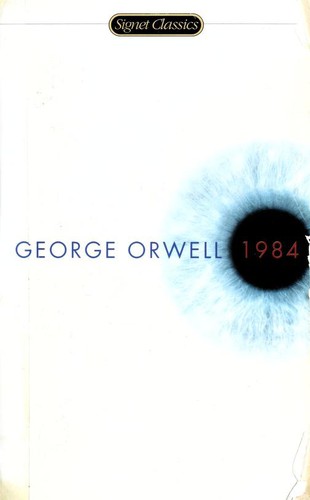
A dystopian vision of a state that controls not just behavior but thought itself, told through one man's doomed attempt to hold onto a private inner life the Party is determined to reach.
Winston Smith works at the Ministry of Truth in a London that belongs to Oceania, one of three permanently warring superstates. His job is to rewrite historical records so they always agree with whatever the Party currently claims to be true. He lives under constant watch from telescreens, surrounded by posters of Big Brother, in a society where independent thought itself, "thoughtcrime," is the most serious offense there is.
The novel follows Winston's quiet, escalating rebellion: keeping an illegal diary, beginning an affair with a coworker named Julia, and eventually reaching out to a man he believes is part of an underground resistance. None of this is really about overthrowing the Party. It's about proving to himself that an inner life, a private self the Party doesn't own, is still possible.
What makes 1984 more than a period piece about totalitarianism is how precisely it maps the mechanics of control: not just violence, but language, memory, and the psychological pressure of being watched. The Party doesn't need to convince Winston it's right. It needs to convince him that he has no independent basis from which to disagree, and the novel is unflinching about how far it's willing to go to get there.
Orwell spends the opening chapters building the texture of Oceania before introducing any plot: the telescreens that watch and listen everywhere, the Thought Police, the Two Minutes Hate, the physical decay of a society that produces nothing but propaganda and weapons. Winston is established as an unremarkable functionary, not a natural rebel, which is the point — this system is built to work on ordinary people.
"War is Peace. Freedom is Slavery. Ignorance is Strength." These aren't decorative contradictions. Each one describes an actual mechanism: perpetual war justifies perpetual scarcity and control, surrendering individual freedom to the collective is framed as safety, and a citizenry kept ignorant of history and the outside world can't compare its situation to anything better.
Winston's decision to write "DOWN WITH BIG BROTHER" in a diary is the inciting act of the book, and Orwell frames it correctly: the crime isn't the sentence, it's the act of thinking independently enough to write it. From this point Winston knows he is, in the Party's language, already dead.
Julia's rebellion is more instinctive and less ideological than Winston's, she isn't interested in overthrowing the Party in the abstract, she just wants to steal pleasure and privacy for herself. Their relationship matters to the plot precisely because it's private: a bond that exists outside the Party's reach is, structurally, the same threat as an organized conspiracy.
The room Winston rents from Mr. Charrington becomes a stand-in for the past itself, old, non-utilitarian, without a telescreen. Believing they've found a blind spot, Winston and Julia let themselves imagine a future. Orwell uses this false sense of safety to make the eventual betrayal land harder.
Winston's belief that O'Brien is a fellow conspirator, and his willingness to hand Julia a book supposedly written by the resistance leader Goldstein, shows how badly he wants the Party's opposition to be real and organized. The book he reads ("The Theory and Practice of Oligarchical Collectivism") is the clearest statement in the novel of how the three superstates function and why perpetual war benefits all of them equally.
Once Winston and Julia are captured, the book shifts from a story about resistance to a study in what total psychological control actually looks like. O'Brien reveals himself as Winston's interrogator, not his ally, and explains, almost patiently, that the Party's goal was never to make Winston obey. It's to make him believe.
The torture in the Ministry of Love isn't random cruelty, it's targeted at the specific thing the Party needs destroyed: Winston's confidence that his own perception of reality is valid. "How many fingers, Winston?" is the whole thesis of the book compressed into one scene — if the Party says it's five, then for you, it has to become five.
Room 101 doesn't use generic pain, it uses each prisoner's specific worst fear. For Winston, that's rats. Faced with them, he screams for the torture to be inflicted on Julia instead — the one act he'd told himself, throughout the whole book, that he would never do. The tragedy isn't that he breaks. It's that breaking is engineered to be inevitable for anyone.
The final lines aren't a twist, they're the confirmation that doublethink worked. Winston doesn't just comply outwardly, he genuinely comes to love the thing that destroyed him. Orwell denies the reader a redemptive ending on purpose, because a redemptive ending would undercut the entire argument about how total this kind of control can be.
Often skipped, but worth reading: Orwell's appendix lays out how Newspeak works as a mechanism, not just flavor text. By steadily shrinking vocabulary, the Party isn't just controlling what people can say, it's engineering what they'll eventually be able to think. Words like "freedom" survive only in stripped, politically safe senses ("this dog is free from lice"), while the political sense of the word is deliberately erased. It's the most literal illustration in the book of the idea that language and thought are the same battlefield.
I first read this because it's a classic, but it hit differently once I was a few years into a Cybersecurity & Privacy degree and now working in cloud security. The telescreen isn't speculative fiction anymore, it's a rough draft of always-on cameras, microphones, and location data that most people carry voluntarily. The uncomfortable part isn't that the surveillance capability exists, it's Orwell's insight that uncertainty about being watched does more behavioral work than being watched constantly ever could. That's directly relevant to how I think about controls at work: a well-designed control often doesn't need to catch every violation, it just needs to make people assume they might be caught.
The idea that stuck with me most, though, isn't really about surveillance technology at all. It's that the Party's real target was never Winston's actions, it was his confidence in his own read of reality. That's a much broader idea than security or politics. Anywhere someone is being pressured to doubt what they clearly observed, whether that's gaslighting in a relationship, a workplace, or coordinated disinformation at scale, the mechanism Orwell describes is the same one. Reading it as a warning about privacy is correct but incomplete; it's really a warning about what happens when you let someone else become the final authority on what's true, even inside your own head.