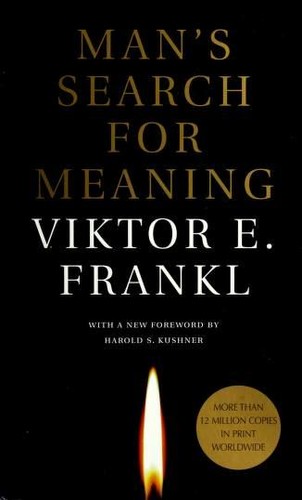
A psychiatrist's account of surviving the concentration camps, built into a framework for finding purpose even when your circumstances are completely outside your control.
The first half of the book is Frankl's account of his years in Auschwitz and other Nazi concentration camps, but it's observed with the eye of a psychiatrist rather than told purely as a survivor's memoir. He's less interested in cataloguing the horror, though he doesn't shy from it, than in a specific question: given that everyone in the camps faced roughly the same brutal conditions, why did some people hold onto their humanity while others didn't?
The second half builds his answer into logotherapy, the psychological framework Frankl developed, centered on the idea that the primary human drive isn't pleasure (Freud) or power (Adler) but meaning. People, he argues, can tolerate almost any "how" if they have a strong enough "why." The book's lasting power comes from the fact that this isn't an abstract philosophical claim, it's a conclusion Frankl watched play out, repeatedly, in the worst conditions imaginable.
Frankl describes arrival at Auschwitz through the psychiatric lens of "delusion of reprieve," the mind's refusal to accept the full reality of the situation. Belongings, clothes, even names are stripped away and replaced with a tattooed number. What follows is a kind of clinical detachment Frankl calls on to survive the selection process itself, where a flick of a hand decided who lived and who went straight to the gas chambers.
After the initial shock, Frankl describes a numbing that sets in as a psychological defense, a kind of emotional death that let prisoners witness horrific things without being destroyed by each one individually. Within this apathy, he identifies the moments that mattered most: a sunset over the Bavarian hills that moved prisoners to tears, imagining conversations with his wife, small acts of humor or defiance. These weren't distractions from suffering, they were evidence that an inner life could still exist independent of it.
This section contains the book's central turning point: Frankl's realization, while marching in the freezing dark, that his love for his wife (whom he did not know at the time was alive or dead) gave him a reason to endure the moment. "The salvation of man is through love and in love," he writes, arrived at not as a platitude but as a survival mechanism discovered in real time.
The least discussed but psychologically sharpest section. Frankl describes "depersonalization," the numb inability to feel joy even at liberation, and the bitterness some survivors felt on returning home to find their suffering met with indifference, or worse, their families gone. Freedom, he notes, isn't automatically restorative, readjusting to it is its own psychological task.
Frankl positions logotherapy against Freud's will to pleasure and Adler's will to power: the primary human motivation, he argues, is a will to meaning. When that will is frustrated, what he calls the "existential vacuum," people often try to fill it with pleasure-seeking, power-seeking, or conformity, none of which actually resolve the underlying emptiness.
Frankl's framework doesn't promise a pain-free life, it explicitly rejects that promise. Instead he argues for "tragic optimism," the capacity to turn suffering into achievement, guilt into self-improvement, and the transience of life into motivation to act meaningfully, rather than into despair. It's optimism that has actually accounted for the tragic, not one that ignores it.
The line that's stayed with me most is that the last human freedom is choosing your response to circumstances you can't control. It's a heavier version of the same idea Marcus Aurelius works through in Meditations, but earned in a completely different way given what Frankl actually lived through. Reading them close together made the Stoic framework feel less like a philosophy and more like something people independently rediscover under real pressure.
The three roads to meaning have quietly become a check-in question I run on my own life, especially since career changes always throw this into sharper focus. I've moved through the defense industry, a startup, and now cloud security, and each move was really me looking for more of that first road, meaningful work, rather than chasing title or comfort for its own sake. Frankl's insight that success and happiness can't be pursued directly, only earned as a side effect of dedication to something larger, is a useful check against optimizing my career for the wrong metric.
It's a short book but not a fast read. I found it worth sitting with a chapter at a time rather than rushing through, given the weight of the subject matter.