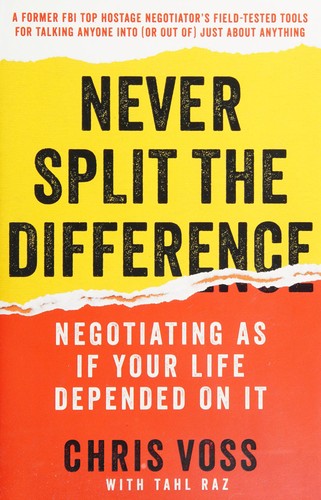
Negotiation tactics from a former FBI lead hostage negotiator, built around tactical empathy, a sharper, higher-stakes companion to the warmer approach in How to Win Friends.
Voss draws on his career negotiating hostage situations for the FBI, kidnappings, bank robberies, terrorist standoffs, to build a negotiation framework centered on emotional intelligence rather than pure logic or leverage. Where a lot of negotiation advice focuses on rational arguments and anchoring numbers, Voss argues that emotions drive most decisions, and that a negotiator who can accurately name and validate the other side's emotions gets further than one who ignores them.
The book moves through a specific toolkit chapter by chapter: mirroring and tactical empathy to build rapport, labeling to defuse negative emotion, the strategic use of "no," calibrated questions to get the other side invested in solving your problem, methods for guaranteeing follow-through, and hard-bargaining tactics for the endgame. It closes with the idea of the "Black Swan," unknown information that can reshape the entire negotiation once found, arguing that every deal has at least a few of them.
Voss opens by dismantling the idea that negotiation is a rational, logical exercise. It's driven by emotion, and the fastest way to earn trust is tactical empathy, demonstrating you understand the other side's perspective and feelings, without necessarily agreeing with them. Mirroring, simply repeating the last one to three words someone said, sounds almost too simple to work, but it reliably gets people to elaborate and feel heard, buying you time and information at almost no cost.
Labeling means naming an emotion you observe out loud: "It seems like you're worried about the timeline" or "It sounds like this deal falling through would be a real problem for you." Voss argues labeling a negative emotion defuses it, while ignoring it lets it build. Crucially, labels are stated as observations, not accusations, which lowers the other person's defenses instead of raising them.
Chasing an early "yes" often produces a counterfeit one, agreement given just to end the pressure, which falls apart later. Voss argues "no" is actually the safer, more productive answer to pursue first: it makes people feel in control and protected, which paradoxically opens them up to real conversation. Questions like "Is now a bad time to talk?" are designed to invite a comfortable "no" that actually moves things forward.
The two words are "That's right." Voss distinguishes this from "You're right," which people say just to end a conversation. Getting to "that's right," usually by summarizing the other person's situation and feelings back to them accurately, signals that they feel truly understood, which is often the turning point where real cooperation starts.
Voss covers how to anchor emotionally before anchoring on numbers (for example, opening by naming how extreme the ask might sound), and how to use calibrated, open-ended "how" and "what" questions ("How am I supposed to do that?") instead of demands. These questions hand the problem back to the other side and let them feel like they're the ones generating the solution, while you steer the outcome.
Getting a "yes" isn't the finish line, agreements fall apart at the implementation stage constantly. Voss breaks "yes" into three types: counterfeit (said to end the conversation), confirmation (a simple, real but non-committal agreement), and commitment (a genuine yes that leads to action). The chapter's tools, including a "summary" that forces the other side to say "that's right" one more time, are aimed specifically at converting a deal into something that actually gets executed.
Here Voss gets tactical about the endgame, including the "Ackerman model," a structured way of making concessions in decreasing, non-round increments (for example 65%, 85%, 95%, then 100% of your target) that feels like real, hard-won progress to the other side rather than an arbitrary retreat.
Every negotiation contains unknown unknowns, pieces of information that, if surfaced, would change your entire approach. Voss closes on three types of leverage (positive: what you can offer, negative: what you can threaten to withhold, normative: the other side's own standards and past statements used against inconsistency) and argues that patient, curious listening is what actually surfaces the Black Swans that unlock a deal.
The mirroring and labeling techniques are simple enough to actually use in regular conversations, not just formal negotiations, and they pair naturally with the body language reading from Navarro's book, being able to read discomfort and then name it out loud is a strong combination. I've caught myself using a label mid-conversation at work just to de-escalate a tense moment, and it works noticeably better than trying to argue someone out of a feeling.
The "no" chapter reframed a habit I used to see as a weakness, giving people an easy off-ramp instead of pushing for a quick yes, as actually a deliberate, effective tactic. It's made me more patient in conversations where I used to feel pressure to close things out fast.
This reads as a sharper, more tactical companion to How to Win Friends, Carnegie's approach is about warmth and genuine interest as an end in itself, Voss's is the same underlying empathy applied under higher-stakes, more adversarial conditions where the other side may not have your best interest in mind at all.