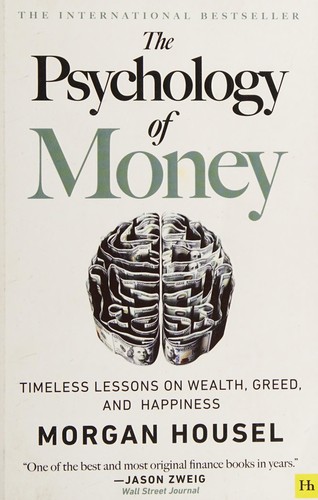
Building wealth has less to do with what you know about investing and more to do with how you behave, especially when markets, and life, get uncomfortable.
Housel argues that personal finance is more personal than it is finance, two people with identical income and identical investment knowledge can end up in completely different places because of differences in temperament, patience, and how they handle uncertainty. The book is a series of short, standalone essays rather than a step-by-step system, each built around a specific behavioral trap or insight.
Running underneath all of it is a consistent argument: outcomes in money are driven far more by psychology, how you handle fear, greed, envy, and uncertainty, than by formulas or technical knowledge. The people who do best with money over the long run aren't necessarily the smartest, they're the ones who can stay reasonable, patient, and in the game long enough for compounding to take over.
Housel opens by pointing out that everyone's financial decisions make sense to them given their own experience, someone who came of age during a market crash will treat risk completely differently than someone who came of age during a boom, and neither is irrational, they're just extrapolating from different personal histories. Paired with this is the "Luck & Risk" chapter: identical decisions can produce wildly different outcomes depending on luck, so judging a financial decision purely by its result (yours or someone else's) is misleading. Better to study broad patterns of behavior than to imitate a specific person's outcome.
Even extremely wealthy, successful people have blown everything up by moving the goalpost on "enough," taking bigger and bigger risks with something they already had (reputation, freedom, family) to chase more of something they didn't need. Knowing when you have enough is treated as one of the most underrated financial skills.
Buying visible signs of wealth doesn't earn you the admiration you're hoping for, other people are just admiring the car or the watch, not you, and often using it as a benchmark to want one for themselves. If the goal is respect, spending less and being kind, generous, and humble tends to work better than spending more.
Wealth is the money not spent, it's invisible by definition. Rich (a high income or visible lifestyle) and wealthy (accumulated, unspent assets) are treated as different, often unrelated things, and confusing the two is one of the most common financial mistakes.
Housel uses Warren Buffett's net worth to make the point directly: the overwhelming majority of it was built after age 50, not because his returns were unusually spectacular, but because he started early and kept compounding for an unusually long time. Time in the market, not timing the market or beating the market, is the real engine.
These require different, sometimes opposite skills. Getting wealthy can reward optimism and swinging for the fences; staying wealthy requires humility, fear of losing it all, and frugality. A lot of financial blowups come from applying "getting wealthy" behavior indefinitely instead of shifting gears once you have something to protect.
A small number of outsized outcomes drive the majority of returns in investing (and business, and life), so being wrong often, as long as you stay in the game to catch the rare big wins, is completely normal and not a sign of failure.
Because the future is unpredictable, building in a margin of safety, not maximizing every decision for the best-case scenario, is what actually lets you survive long enough to benefit from compounding. Overoptimizing for the "expected" outcome leaves no cushion for the ones you didn't expect.
Long-term financial plans should account for the fact that your future self will have different goals and values than your current self, planning as if today's preferences are permanent is a common and costly mistake.
The mathematically optimal financial decision isn't always the one you can actually stick with emotionally, and a "reasonable" plan you'll actually follow for 30 years beats a theoretically optimal one you abandon in year three.
Housel argues the highest dividend money pays isn't a lifestyle upgrade, it's control over your own time. Saving money doesn't require a specific goal, it's a hedge against a future you can't predict, and the "Surprise!" chapter reinforces that the biggest financial events in history were the ones nobody saw coming, which is itself an argument for margin and flexibility over precise forecasting.
Volatility and loss are the "price of admission" to long-term investment returns, not a sign something's gone wrong. And because different investors (day traders, long-term index investors, speculators) are effectively playing different games with different rules, taking cues from someone playing a different game than you is a fast way to make a decision that doesn't fit your actual situation.
The closing chapters lay out Housel's personal financial habits directly: a high savings rate independent of income growth, avoiding debt, staying patient, and prioritizing flexibility and independence over maximizing every possible return. It's less a formula to copy exactly and more a demonstration of what taking the book's own lessons seriously actually looks like in practice.
The framing that wealth is what you don't spend, not what you earn, is a useful gut check now that I'm a few years into a full-time salary. It's easy to treat a raise or a promotion as automatic permission to spend more instead of as an opportunity to widen the gap between what I earn and what I actually need.
The point about everyone playing a different financial game resonated too. Comparing my risk tolerance or investment choices to a coworker or friend without knowing their full financial picture, family situation, or timeline is a common way to end up making a decision that doesn't actually fit my own goals. Reading this alongside Rich Dad Poor Dad was useful, Kiyosaki is much more about acquiring assets and building income streams, while Housel is almost entirely about the behavioral discipline to hold onto and grow whatever you've already built. Neither one is complete without the other.