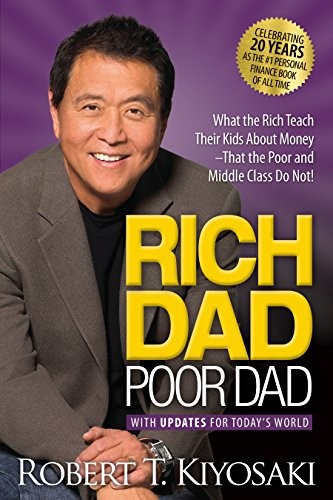
A foundational, if simplified, framework for thinking about assets versus liabilities and why working hard for money isn't the same strategy as building real wealth.
Kiyosaki frames the book around two father figures: his own dad ("Poor Dad," highly educated, a government employee, financially cautious) and his best friend's dad ("Rich Dad," an entrepreneur with an eighth-grade education, financially aggressive), using their contrasting advice to illustrate two different mindsets about money. The "poor dad" advice is to study hard, get a good job, and be careful; the "rich dad" advice is to understand how money actually works and put it to work for you instead of working for it forever.
The central technical point, repeated throughout, is the asset/liability distinction: a house you live in isn't necessarily an asset if it's not generating income, and building real wealth means acquiring things that put cash in your pocket instead of things that just look successful or drain your income every month. The book is less a technical investing manual and more an attempt to rewire how the reader thinks about money, risk, and what "financial security" actually requires.
Kiyosaki's origin story: as a kid, he and his friend try to make money and end up learning from Rich Dad that working purely for a paycheck keeps you on a treadmill controlled by fear and greed, fear of not having enough, then greed for more once you get a raise. The lesson isn't "don't work," it's that your relationship to money should be about learning and building, not just trading hours for a wage.
The core technical lesson of the whole book: the difference between an asset (puts money in your pocket) and a liability (takes money out), and the different cash-flow patterns of the poor, the middle class, and the rich. The poor generate income and spend it on expenses; the middle class generates income and spends it on liabilities they mistake for assets (a bigger house, new cars); the rich generate income, buy assets, and let those assets buy their liabilities for them.
A distinction between your profession (what you do to earn income) and your business (the asset column you're building on the side). Kiyosaki's advice is to keep your day job but spend real effort building your asset column, real estate, stocks, businesses, intellectual property, rather than pouring every spare dollar into a bigger lifestyle.
A simplified walkthrough of why corporations can legally structure income, expenses, and taxes differently than an individual employee can, spending pre-tax dollars on certain expenses before being taxed on what's left, versus an employee who's taxed first and spends what remains. Kiyosaki uses this to argue that understanding legal financial structures, not just working harder, is part of financial literacy.
Financial intelligence, in Kiyosaki's framing, is the ability to recognize opportunities everyone else misses, and to act on them with knowledge instead of needing to already have money. He argues that being your own expert, not outsourcing every financial decision to a broker or advisor, is part of what separates people who build wealth from people who don't.
Advice aimed at people early in their career: prioritize jobs and experiences that teach you widely useful skills (sales, management, communication, systems thinking) over jobs that just pay the most right now. Specialization can raise your ceiling within one lane, but breadth of skill is what actually lets you build and run something of your own later.
The closing sections name five reasons people who understand this framework intellectually still don't act on it: fear (of loss), cynicism (doubt dressed up as realism), laziness (often disguised as being "busy"), bad habits (spending patterns set early and rarely questioned), and arrogance (assuming you already know enough). Kiyosaki follows this with a practical nudge to start small: buy one asset, negotiate one deal, take one class, treat wealth-building as a skill developed through repetition, not a single big move.
This is more of a mindset-shifting book than a technical one, worth reading for the reframe rather than for specific investment tactics, and I'd take the parts that read as absolute rules (especially around real estate and corporate structures) with a grain of salt given how much has changed, and how simplified some of it is, since it was written. The asset/liability distinction is simple but it's genuinely changed how I look at big purchases, including how I think about a car, is it something that only costs me money every month, or does maintaining and understanding it myself turn it into a skill and a hobby with its own value, versus paying someone else for all of it.
The "work to learn, don't work for money" lesson also landed given how I've moved between the defense industry, a startup, and now cloud security rather than staying on one narrow track. Each move was as much about picking up broadly useful skills as it was about the paycheck at the time.
Worth pairing with something more numbers-driven and behaviorally rigorous like The Psychology of Money, since this book is much stronger on mindset than on the specifics of actually executing a long-term financial plan.