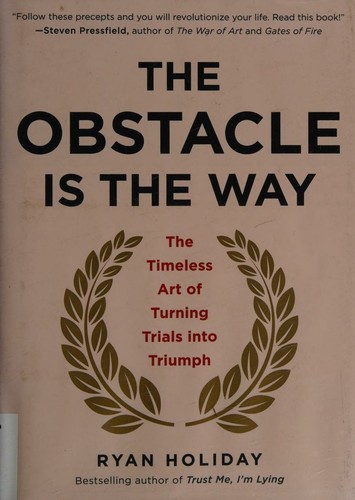
A modern, practical take on Stoicism built around the idea that obstacles aren't blocking your path, they are the path, if you can reframe them as fuel instead of setbacks.
Holiday structures the book around a three-part Stoic framework: perception (how you see a situation), action (what you actually do about it), and will (the internal resolve to keep going when it's genuinely hard, or when the outcome is out of your hands). Each section is illustrated with short historical examples, industrialists, generals, athletes, and political figures who turned a specific setback into an advantage by changing how they approached it rather than by getting lucky.
It's a more tactical, applied companion to Meditations, less about internal philosophy on its own and more a field manual for how to actually act when things go wrong: how to see the situation clearly first, how to move from clear sight into deliberate action, and how to sustain the will to keep going once the initial obstacle has been dealt with and a bigger one shows up behind it.
The first discipline is about seeing a situation exactly as it is, stripped of the exaggeration, panic, or added emotional judgment we naturally layer on top of events. Holiday opens with John D. Rockefeller staying calm and clear-headed during financial panics that ruined less composed competitors, using the calm itself as a competitive advantage. The core exercises in this section are about separating the objective facts of a situation from your subjective reaction to it (a direct application of the dichotomy of control from Meditations), and treating a setback as neutral raw material rather than a verdict on you personally.
Clear perception is worthless without follow-through, so this section is about disciplined, often unglamorous movement. Thomas Edison's relentless iteration through thousands of failed experiments is used to argue that persistence, not raw talent, is what actually resolves most hard problems. Holiday also covers the "flank attack," borrowed from military strategy, the idea that a direct assault on an obstacle isn't always the smartest option, and that going around, adapting the plan, or attacking the problem from an unexpected angle is often more effective than brute force. Process over outcome is a recurring theme here: focusing on the next right action in front of you, rather than the size of the overall problem, is what makes sustained effort psychologically possible.
The final discipline covers what happens when perception and action have both been applied and the obstacle still isn't fully resolved, situations genuinely outside your control, like illness, loss, or fate. Holiday introduces the idea of the "inner citadel," a core of character and self-possession that external events can't reach, drawing directly on Marcus Aurelius. He also covers premeditatio malorum, the Stoic practice of mentally rehearsing setbacks in advance so they're less destabilizing if they actually happen, and amor fati, not just accepting a bad outcome but genuinely working to make use of it, treating what happened to you as material rather than injury.
The short, example-driven chapters make it easy to read in small chunks, and the historical case studies make the ideas feel less abstract than a pure philosophy text. The "flank attack" idea in particular has changed how I approach getting stuck on something, whether that's a car problem I can't diagnose head-on or a photo that isn't working, stepping back and trying a completely different angle usually beats forcing the original approach harder.
The action section is the one I come back to most, mostly because learning to work on my own car, or getting back into figure skating as an adult, involves constant, visible failure. Treating each stalled repair or fallen jump as the expected process rather than a setback to feel bad about has made it much easier to actually stick with those skills long enough to improve at them. That's really the book's whole argument in miniature: the obstacle (the failed attempt) isn't separate from getting good at something, it is how you get good at it.
Pairs naturally with Meditations, this is closer to the application layer, Marcus Aurelius is closer to the underlying philosophy that Holiday is translating into modern, practical language.