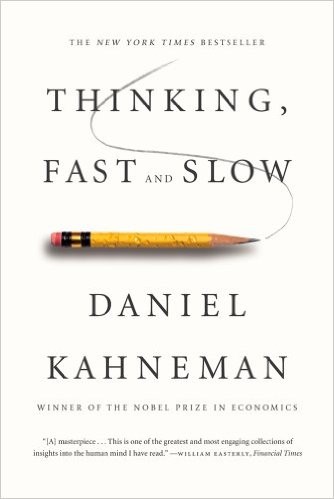
A deep look at the two systems driving human decision-making, the fast, intuitive one and the slow, deliberate one, and why the fast one is more error-prone than it feels in the moment.
Kahneman, drawing on decades of research with Amos Tversky, breaks human thinking into two systems: System 1, fast, automatic, and intuitive, and System 2, slow, deliberate, and effortful. Most of what we do runs on System 1, which is efficient and usually good enough, but systematically biased in specific, predictable ways that Kahneman spends the bulk of the book cataloguing.
The book is organized into five parts that build on each other: introducing the two systems, walking through the specific heuristics and biases that distort judgment, examining overconfidence in expert and everyday predictions, covering the economics of choice (his Nobel-winning prospect theory), and closing with the distinction between the "experiencing self" and the "remembering self." It's a dense, research-heavy read, closer to a synthesized textbook than a narrative, but the individual concepts are each useful on their own even out of context.
System 1 operates automatically and quickly, recognizing a face, reading an emotion, driving on an empty road, with little or no effort. System 2 allocates attention to effortful mental activities, like filling out a tax form or checking a complex argument, and tends to be "lazy," defaulting to System 1's answer whenever it can get away with it. A key idea here is cognitive ease: things that are easy to process (familiar, repeated, clearly presented) feel more true, which is why repetition alone can make a claim feel more credible regardless of its accuracy.
Any number you're exposed to, even an irrelevant one, anchors subsequent numerical judgments. The availability heuristic means we judge how common or likely something is by how easily examples come to mind, which is why vivid, memorable risks (like plane crashes) get overweighted relative to boring, statistically bigger ones.
People judge probability by how well something matches a stereotype rather than by actual statistical base rates, this is what produces the famous "Linda problem," where people rate a more specific, story-like description of a person as more probable than a broader one, even though that's a logical impossibility.
Extreme results tend to be followed by more average ones simply due to statistical regression, not cause and effect, but our minds are wired to invent causal stories for it anyway. Kahneman calls this the illusion of understanding, our tendency to construct coherent, satisfying narratives out of essentially random sequences of events, and it's closely tied to hindsight bias, the sense that an outcome was predictable all along, after the fact.
Kahneman is blunt about the limits of intuition, especially expert intuition, arguing it's only reliable in environments that are regular and predictable enough to learn from (like chess or firefighting) and unreliable in irregular, low-feedback environments (like stock picking or long-range forecasting). The "planning fallacy" describes our tendency to underestimate costs and timelines by focusing on the specific plan (the "inside view") instead of the track record of similar past projects (the "outside view"). Optimism bias compounds this, most people rate their own risk of bad outcomes as lower than average, which fuels overconfident decisions in business, relationships, and personal planning alike.
This section lays out prospect theory, the framework that won Kahneman the Nobel Prize in Economics. Instead of evaluating outcomes in absolute terms, people evaluate them relative to a reference point, and losses relative to that point hurt roughly twice as much as equivalent gains feel good, a pattern called loss aversion. This produces the "fourfold pattern": people are risk-averse when protecting a likely gain but risk-seeking when trying to avoid a likely loss, which explains behavior (like holding onto losing investments too long) that looks irrational from a purely logical standpoint. The endowment effect and framing effects round this section out, simply owning something increases how much you value it, and how a choice is worded (90% survival vs. 10% mortality) changes the decision even when the underlying facts are identical.
Kahneman closes by distinguishing the experiencing self, who lives through an event moment to moment, from the remembering self, who constructs a summary judgment of it afterward, largely based on the peak moment and the ending (the "peak-end rule"), with the actual duration barely factoring in at all ("duration neglect"). Because we tend to make future decisions based on the remembering self's judgment rather than the experiencing self's, we can systematically choose experiences that were actually worse to live through if they simply ended on a better note.
It's a dense read, more textbook than narrative in places, but the individual bias sections are useful on their own even without reading the whole thing linearly. I've gone back to specific chapters (anchoring, base-rate neglect) more than I've reread the book cover to cover.
The most practically useful idea for my day job is just knowing which system is likely driving a given decision. Risk assessments and incident response in security are full of exactly the traps Kahneman describes: availability bias makes a recent, vivid incident feel like a bigger threat than a boring, statistically far more common one; base-rate neglect makes an unusual, attention-grabbing alert feel more significant than the base rate of it actually being malicious; and the planning fallacy shows up constantly in how long a "quick fix" is estimated to take. Slowing down enough to notice "this is a System 1 snap judgment, what would the outside view say" is a small habit that's caught a surprising number of bad calls before they happened, both at work and in personal decisions.
The two-selves distinction has also quietly changed how I think about trips and photography outings, the peak-end rule is a decent argument for making sure an experience ends well, even if that means cutting a mediocre stretch short, since that's disproportionately what I'll actually remember and want to repeat.